Emergency Guides
Hail Just Hit Dauphin County: 5 Things to Do in 48 Hours
Hail evidence disappears fast. Splatter marks fade within days and soft-metal dents weather. Here are the five things to do while the proof still exists.

The short answer
Photograph the hailstones and the splatter marks within days — that evidence disappears fastest. Check every soft metal on the property for dents, get a free professional inspection while the damage is fresh, read your wind and hail deductible before filing, and be careful about who knocks on your door.
Hail damage is the most misunderstood roof damage there is, because the roof usually looks completely fine afterward.
A hailstone hits an asphalt shingle and does two things: knocks the mineral granules off the surface, and bruises the fiberglass mat underneath. The granules are what protect the asphalt from ultraviolet light. Once they are gone from a spot, that spot ages several times faster than the shingle around it.
So the roof looks fine after the storm. It looks fine next spring. Then five years later you have leaks across a roof that should have had a decade left, and the storm that caused it is far outside any claim window.
Here is what to do in the next 48 hours.
1. Photograph the evidence that is about to disappear

Several kinds of hail evidence are temporary and they are the most convincing kind.
Photograph hailstones themselves next to a coin or a ruler for scale, ideally in your hand or on the ground at your address. Photograph splatter marks — the clean spots where hail knocked dirt and oxidation off a deck rail, a fence, a painted surface or a window sill. Those fade within days and they are excellent evidence of both hail size and the fact that it fell here.
Do this first, before anything else on this list.
2. Check your soft metals from the ground
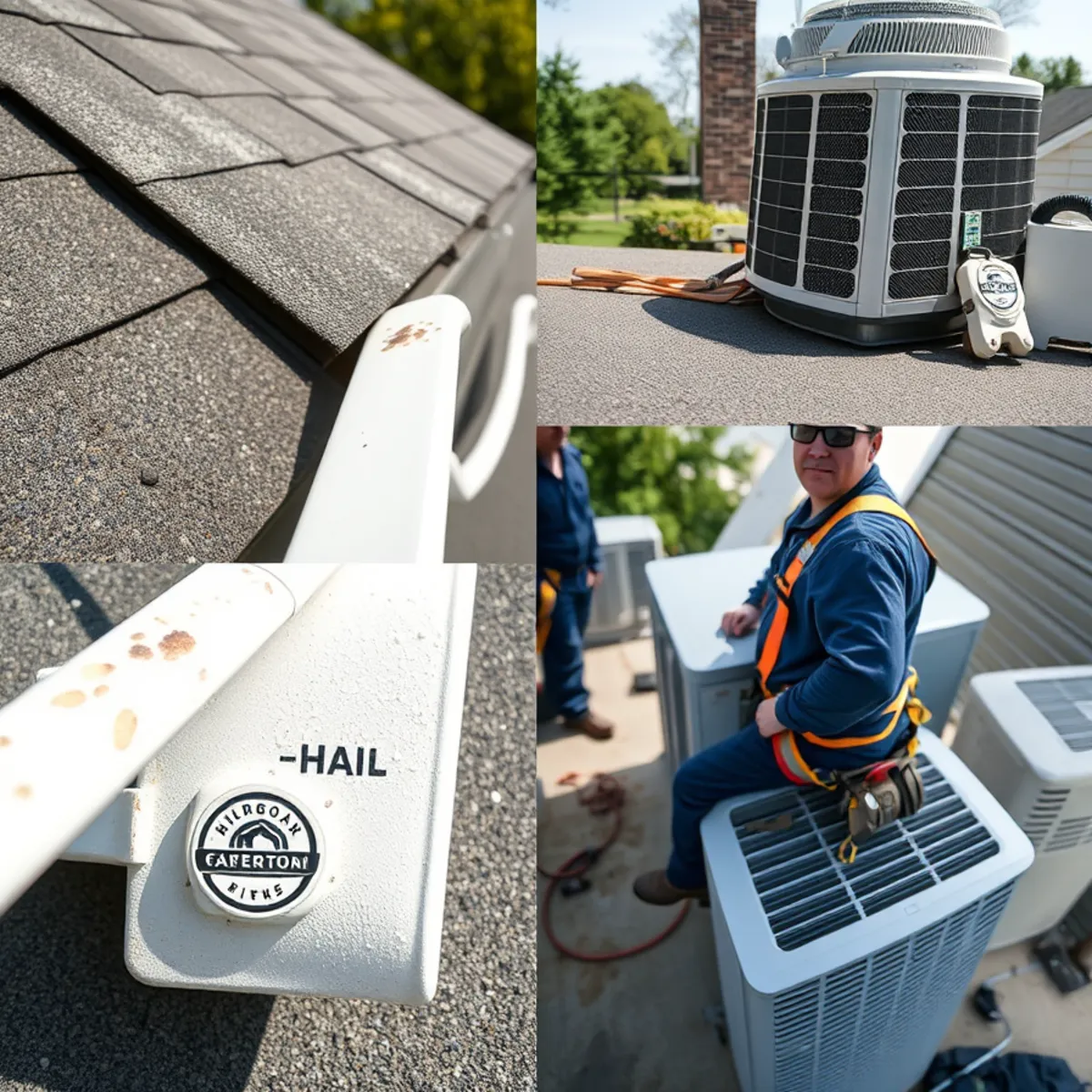
You do not need to get on the roof to know whether damaging hail hit your property. Aluminum records it honestly.
- Gutter faces and downspouts — dimples and dents in the flat surfaces
- Drip edge along the eaves — visible from the ground on most houses
- Furnace and plumbing vent caps — these sit high and take direct hits
- Window wraps, door wraps and screens — dents and tears
- Air conditioner condenser fins — bent or flattened fins on the outdoor unit
- Fence caps, mailboxes, grills and garage doors — anything painted metal at your address
3. Get a free professional inspection while the damage is fresh

The roof itself needs someone on it. Hail bruising is genuinely invisible from the ground — the giveaway is a dark circular spot where granules are gone, and when you press it, it gives slightly, like a bruise on fruit.
A proper inspection marks a 10-by-10 test square on each slope and counts impacts within it, because impact density per square is the measurement carriers actually use to decide whether a slope is repaired or replaced. It also photographs each hit with a scale reference and checks the attic.
Our hail damage inspection is free and produces a written report whether or not there is damage. If there is nothing to claim, we will tell you that — a roofer who finds damage on every roof is not inspecting, they are selling.
4. Understand your policy before you file

Two lines on your declarations page matter enormously.
First, the wind and hail deductible. Many Pennsylvania policies carry a separate, higher deductible for wind and hail losses, frequently expressed as a percentage of dwelling coverage. On a $300,000 dwelling limit, a 2% wind/hail deductible is $6,000 — which may exceed the value of a modest repair.
Second, ACV versus replacement cost. An actual cash value policy pays the depreciated value of your roof and never releases the rest. A replacement cost policy pays depreciated value up front and releases the withheld depreciation once the work is completed and documented. On a fifteen-year-old roof, the difference is thousands.
5. Be careful about who knocks on your door

After a significant Dauphin County hail event, out-of-state crews arrive within a day or two. Some are legitimate operations working a storm. Many are not.
The signals to walk away from: an offer to cover or waive your deductible — that is insurance fraud in Pennsylvania and it voids your claim; a guarantee of approval before an adjuster has seen the roof, which nobody can honestly give; high-pressure same-day-only pricing; and any contract assigning your insurance benefits to the contractor that you have not read carefully with time to think.
Ask for a Pennsylvania address you can drive to and a contractor registration number. That single question resolves most of it.
What hail damage actually looks like
| Sign | Hail | Not hail |
|---|---|---|
| Pattern | Random, scattered, non-directional | Rows or lines suggest foot traffic or manufacturing defect |
| Granule loss | Circular spots with sharp edges | Broad uniform loss across a slope is age |
| Mat condition | Soft or bruised when pressed | Brittle and cracked throughout is age |
| Soft metals | Dents in gutters, caps, fins | Clean soft metals means no damaging hail fell here |
| Age of damage | Bright, unweathered exposed asphalt | Darkened, weathered exposure is old |
What to do next
Hail is the one form of roof damage where doing nothing has a deadline. The stones melt, the splatter marks fade, the claim window narrows, and the bruising sits there ageing your roof quietly for five years until it starts leaking.
If hail came through your street recently, get inspected now even if the roof looks perfect from the driveway. It is free, it takes under an hour, and you get the written report whether or not there is anything to claim. See hail damage roof repair.
Questions we get about this
How small can hail be and still damage a roof?
Roughly one-inch hail is where damage to asphalt typically begins, though an older or lower-grade shingle bruises sooner. Anything approaching golf-ball size will mark almost any conventional shingle it strikes squarely.
Will filing a hail claim raise my premium?
Weather claims are generally treated differently from liability claims, and a single storm claim during a region-wide event is not the same as a pattern of claims. Ask your agent directly before filing so you are making an informed decision rather than guessing.
Do I have to accept my insurer's repair estimate?
No. The estimate is a starting scope, and where it omits work the job genuinely requires — ice and water shield, drip edge, ventilation, steep or high charges — a documented supplement is a routine part of the process rather than a confrontation.
Need help with this in Harrisburg?
We are a licensed and insured roofing contractor based at 1000 N Cameron St in Harrisburg. Free inspections, written reports and honest recommendations.
Related services
Areas mentioned