Commercial & Property Managers
Warehouse & Industrial Roofing Around Harrisburg International Airport
At warehouse scale, roofing stops being a trade problem and becomes a logistics one. What actually matters on an acre of membrane.
The short answer
At warehouse scale roofing becomes a logistics problem. The membrane is rarely what fails first — blocked internal drains, worn service routes to rooftop units, and perimeter wind uplift account for most of it, and all three are preventable on a twice-yearly visit.
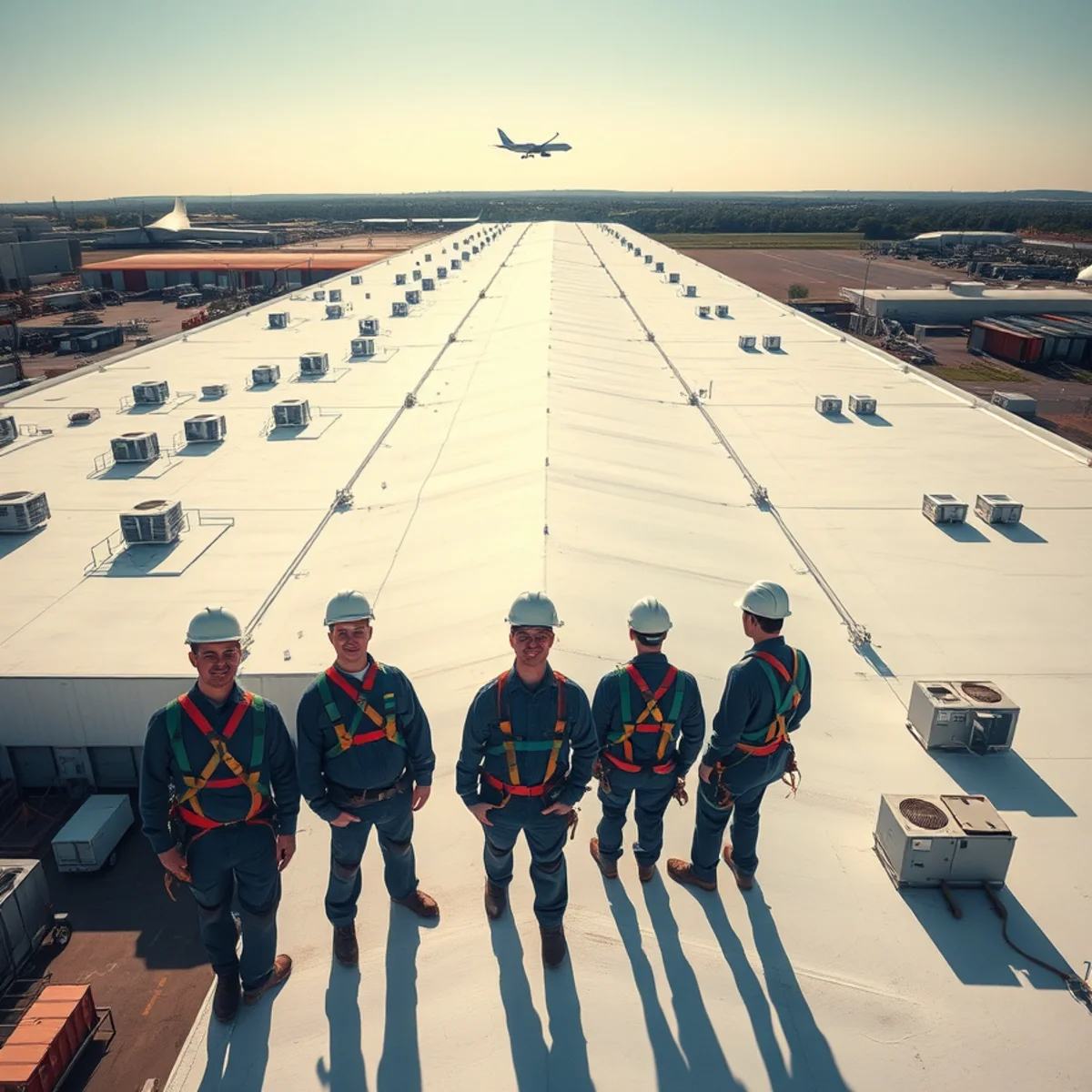
The corridor around Harrisburg International Airport holds one of the densest concentrations of distribution and logistics space in Central Pennsylvania. Lower Swatara, Middletown, Highspire and the ground along I-283 and PA-283 are covered in buildings whose roofs are measured in acres rather than squares.
At that scale the problems change. A small defect on a house is a repair. A small defect over a rack of inventory is a claim, a business interruption and a conversation with a tenant's insurer.
What is on these roofs
The regional standard for new and re-roofed distribution buildings is single-ply — TPO increasingly, EPDM on older stock — mechanically fastened or adhered over insulation on a steel deck, with internal drainage and overflow scuppers.
Older buildings may still carry built-up asphalt with multiple recovers, and some carry metal, either original or as a retrofit over an existing panel roof.
What they all share: enormous continuous membrane area, long perimeter runs, extensive rooftop mechanical equipment, and internal drainage that has to work.
Drainage is the whole ballgame
On a house, a blocked gutter is a nuisance. On a 200,000 square foot warehouse deck, a blocked internal drain during a Central PA summer thunderstorm puts an enormous weight of water on a structure in a very short time.
Standing water is roughly 5.2 pounds per square foot per inch of depth. Across a large deck, a few inches is a load measured in hundreds of tons.
Which is why overflow scuppers exist and why they must be clear. They are the safety valve, and they are the item most commonly found blocked during an inspection. Drain clearing on every maintenance visit is not a formality — it is the single most important thing anyone does on these roofs.
Service traffic and walkway pads
Every rooftop mechanical unit gets serviced, and technicians take the same route from the ladder or hatch to the unit every single time.
Over a decade that route becomes a worn track through the membrane — abraded, thinned, and eventually punctured. It is entirely predictable and entirely preventable.
Walkway pads along service routes and around every unit cost a fraction of the repair they prevent. On any building where we take on maintenance and pads are missing, that is the first recommendation we make.
Wind uplift at the perimeter
The highest wind uplift loads on a low-slope roof occur at the perimeter and, most acutely, at the corners. That is where edge metal, the fastening pattern and the first few feet of membrane earn their specification.
On large buildings in relatively open ground — which describes most of the airport corridor — this matters more than on a sheltered urban roof. Perimeter and corner fastening patterns should be enhanced per the system's wind design, and edge metal should meet the relevant standard rather than being whatever was on the truck.
It is also the first place to inspect after any significant wind event.
Re-cover, restore or replace
| Option | When it fits | What to verify first |
|---|---|---|
| Repair and maintain | Roof is sound, isolated defects | Core samples confirm dry insulation |
| Coating restoration | Membrane weathered but assembly dry and sound | Moisture survey — coating over wet insulation is wasted money |
| Re-cover | One existing layer, dry, code permits another | Layer count, deck condition, code and energy requirements |
| Full tear-off and replace | Wet insulation, multiple layers, failing deck | Disposal cost by weight, phasing plan, operational impact |
| Metal retrofit | Existing metal panel roof | Structural review for added load and attachment |
Doing the work over a live operation
- Phasing — sections sized so nothing is ever open over occupied or inventory-bearing space
- Weather contingency — a defined plan for drying in a phase if conditions turn, agreed before mobilization
- Crane and staging plan — placement, timing and truck routing that does not conflict with dock operations
- Interior protection — over racking, equipment and any sensitive area beneath the work
- Security and site control — materials and equipment secured at every shift end
- Coordination with the tenant's HVAC contractor — for any unit that must be lifted or disconnected
Lifecycle planning
For an owner or asset manager, the right frame is total cost of ownership across the hold period. Membrane thickness and warranty term are budget decisions tied to how long you intend to own the building.
A twenty-year system on a building you plan to sell in five is a different calculation from the same system on a long-hold asset — and so is under-specifying on a building you will still own in 2045.
What makes either decision possible is documented condition data. See commercial flat roof maintenance plans and our commercial roofing service.
What to do next
Get walkway pads installed on every HVAC service route if they are not already there. Technicians take the same path to the same unit for a decade and wear a track through the membrane — it is entirely predictable and it costs a fraction of the repair it prevents.
Then match the specification to your hold period. A twenty-year system on a building you plan to sell in five is a different calculation from the same system on a long-hold asset, and documented condition data is what makes either decision possible. See commercial roofing.
Questions we get about this
How long does a TPO warehouse roof last?
It depends far more on drainage and maintenance than on the membrane. A properly detailed system with working drains, cleared twice a year and repaired promptly, reaches its design life. The same roof with a blocked drain and no walkway pads frequently does not.
Can a large distribution roof be replaced while the building operates?
Yes — it is how most of this work runs. The roof is phased so nothing is ever open over occupied or inventory-bearing space, with crane placement and truck routing agreed against your dock operations and the site secured at every shift end.
What is a moisture survey and do I need one?
It maps where insulation has become saturated, by infrared or core sampling. You need one before any coating or re-cover decision, because covering wet insulation seals the moisture in and shortens the deck's life rather than extending the roof's.
Need help with this in Harrisburg?
We are a licensed and insured roofing contractor based at 1000 N Cameron St in Harrisburg. Free inspections, written reports and honest recommendations.
Related services
Areas mentioned