Harrisburg & Central PA
The Harrisburg Rowhome Owner's Guide to Flat Roof Care
A rowhome flat roof will give you decades of service if someone looks at it twice a year. Ignored, it fails in a way that involves your neighbors.
The short answer
Two inspections a year and one habit: clear the drains and scuppers completely, including the elbow below. A rowhome flat roof with working drainage lasts decades; the same membrane sitting under permanent ponding fails far sooner. Drainage, not brand, is what decides it.
If you own a rowhome in Midtown, Allison Hill, Camp Curtin, Olde Uptown or South Harrisburg, most of your roof is flat, you cannot see it from the street, and there is a reasonable chance nobody has been up there in years.
That is the whole problem. A low-slope membrane roof is not maintenance-free — it is maintenance-light, which is a different thing. Two visits a year keeps one going for decades. Zero visits a year produces the call we get about water coming through a third-floor ceiling.
Here is what actually needs doing.
Twice a year: the fifteen-minute inspection
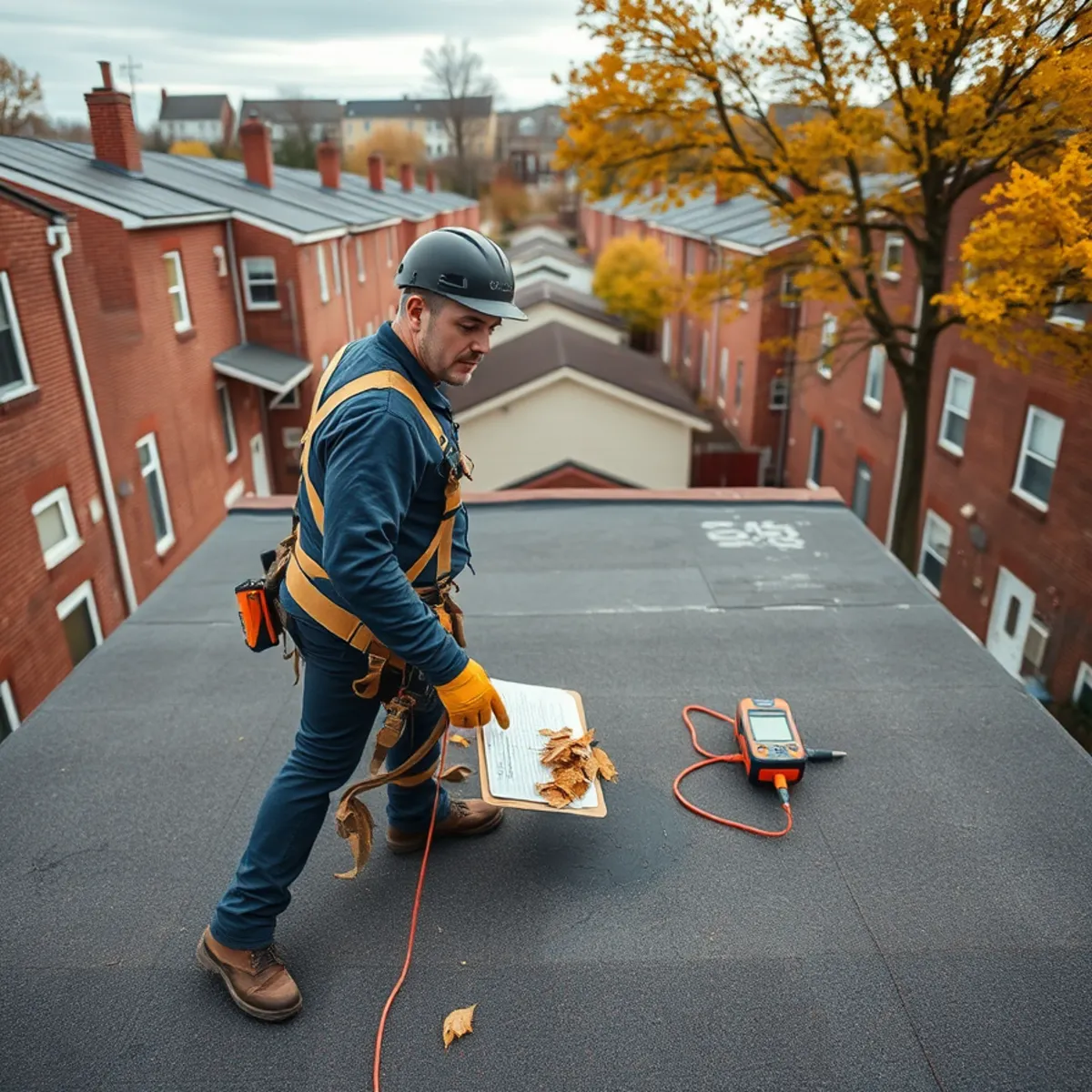
Spring and autumn, plus after any significant storm. If you can safely access the roof, this is what to look at.
- Drains and scuppers — clear them completely, including the elbow below. One blocked scupper turns the whole roof into a basin
- Standing water — check 48 hours after rain. Anything still there is ponding and it is a defect
- Seams — look for fishmouthing, lifting edges, or splits. Seams are where flat roofs fail first
- Terminations at the party walls — the membrane should be mechanically fastened and sealed at the wall, not just stuck down
- Penetrations — vent stacks, exhausts, conduit. Every one is a maintenance point
- Blisters and ridges — trapped moisture expanding. Note them and watch; a split blister is an open hole
- Debris — leaves, branches, seed pods, and anything that holds moisture against the membrane
Autumn is the important one
If you only do one inspection a year, make it late autumn after the trees are bare.
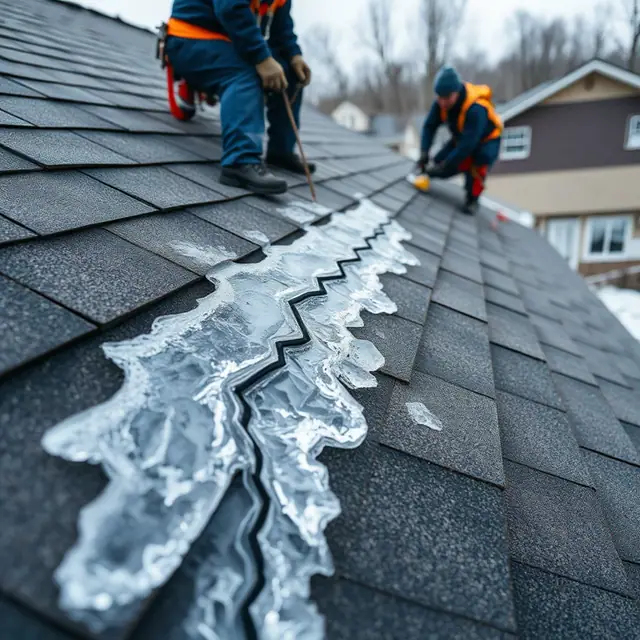
The reason is winter. A blocked drain in November becomes a frozen pond in January, and freeze-thaw works directly on every seam under it. A small seam lift in November becomes a leak the first time meltwater sits on it.
Clear everything, note anything questionable, and get repairs done before the first hard freeze. Autumn repairs are also cheaper — you are booking into a quieter part of the calendar rather than competing with an emergency queue in February.
The party wall — your roof is not entirely yours
This is the specifically rowhome part of the problem.
Your membrane terminates into a wall shared with the house next door, and the detail at that wall protects both properties. When your neighbor re-roofs and their contractor seals the termination with mastic instead of a mechanically fastened term bar, water gets behind it — and the ceiling that stains may well be yours.
Three practical things. Get the party-wall detail photographed on completion whenever work is done, on your side or theirs. Talk to your neighbors when either of you is planning a re-roof, because doing adjacent roofs in the same season lets the tie-ins be detailed together. And if you have unexplained water near a party wall, ask when the neighbor's roof was last worked on.
What you should never do to a flat roof
- Do not walk on it in hot weather. Membrane is soft in summer heat and a boot heel can damage it. Walk in the cool of the morning if you must
- Do not use it as storage. Anything left up there traps moisture and abrades the surface
- Do not apply a hardware-store coating to fix a leak. Coating over wet insulation seals moisture in permanently
- Do not let a satellite or HVAC installer fasten into it without a proper flashed curb or block
- Do not power wash it. You will drive water into every seam
- Do not ignore ponding because it has not leaked yet. It is loading your framing continuously
The five-year check
Every five years or so, get a test core done. It takes ten minutes and it is the only way to know what is under the membrane.
It tells you how many layers are up there, whether the insulation is dry, and what condition the deck is in. That information turns a surprise into a plan — you find out that you have eight years left, or that the insulation is saturated and you should be budgeting now rather than reacting later.
It is also what makes an honest repair-versus-replace decision possible. See flat and low-slope roofing.
Realistic expectations for a rowhome flat roof
A properly installed EPDM or two-ply modified bitumen roof with real drainage should give you decades of service in this climate. The same membrane sitting under permanent ponding, on a deck that has never been cleared, will fail far sooner.
The variable is almost never the brand of membrane. It is drainage, detailing at the perimeter, and whether anyone has looked at it. Those are all things a homeowner can control.
What to do next
If you only do one inspection a year, make it late autumn after the trees are bare. A blocked drain in November is a frozen pond in January, and freeze-thaw spends the winter working directly on every seam underneath it.
Then get a test core every five years or so. Ten minutes tells you how many layers are up there, whether the insulation is dry and what the deck is doing — which turns a surprise replacement into a planned one. See flat and low-slope roofing.
Questions we get about this
How long should a rowhome flat roof last?
A properly installed EPDM or two-ply modified bitumen roof with real drainage should give decades of service in this climate. The same membrane under permanent ponding will fail far sooner — which is why we treat drainage as the specification rather than an accessory.
Can I inspect my own flat roof?
If you can get up there safely, yes, and it is worth doing. Look at the drains, the seams, the terminations at the party walls, any standing water 48 hours after rain, and blisters or ridging. Walk in the cool of the morning, not in summer heat when the membrane is soft.
Whose responsibility is the party wall on a rowhome?
Generally each owner maintains their own half, but the flashing where the two meet protects both properties. It is the most common source of the neighbour dispute that follows a cheap re-roof, which is why we photograph the finished detail for both sides.
Need help with this in Harrisburg?
We are a licensed and insured roofing contractor based at 1000 N Cameron St in Harrisburg. Free inspections, written reports and honest recommendations.
Related services
Areas mentioned