Harrisburg & Central PA
Freeze-Thaw Season: Why January Is Roof Leak Season in Harrisburg
Our call volume for leaks peaks in January and it is not a coincidence. Four separate mechanisms are all running at once.
The short answer
Four mechanisms run at once in a Central PA January: water freezing and widening every small opening, ice dams backing meltwater under the shingles, attic condensation that mimics a leak exactly, and differential material movement working fasteners and sealant loose. That is why a dry October roof leaks in January.
Every January our phone does the same thing, and homeowners are always surprised: the roof was completely fine in October.
It was. And then Central Pennsylvania ran it through several dozen freeze-thaw cycles, which is a mechanical process that finds every marginal detail on a roof and makes it worse.
Four separate mechanisms are at work, and understanding them explains why winter leaks appear where and when they do.
Mechanism 1: water expands when it freezes
Water expands roughly nine percent as it turns to ice, and it does so with substantial force.
A hairline crack in a shingle, a slightly open seam in flashing, a gap at a fastener — each holds a small amount of water. That water freezes, expands, and enlarges the opening slightly. Then it thaws, more water gets in, and the cycle repeats.
Do that thirty or forty times across a winter and a defect that was harmless in autumn is a genuine opening by spring. This is the same process that destroys road surfaces here, applied to your roof.
Mechanism 2: ice dams
The big one, and the reason most January leaks appear at exterior walls rather than in the middle of a ceiling.
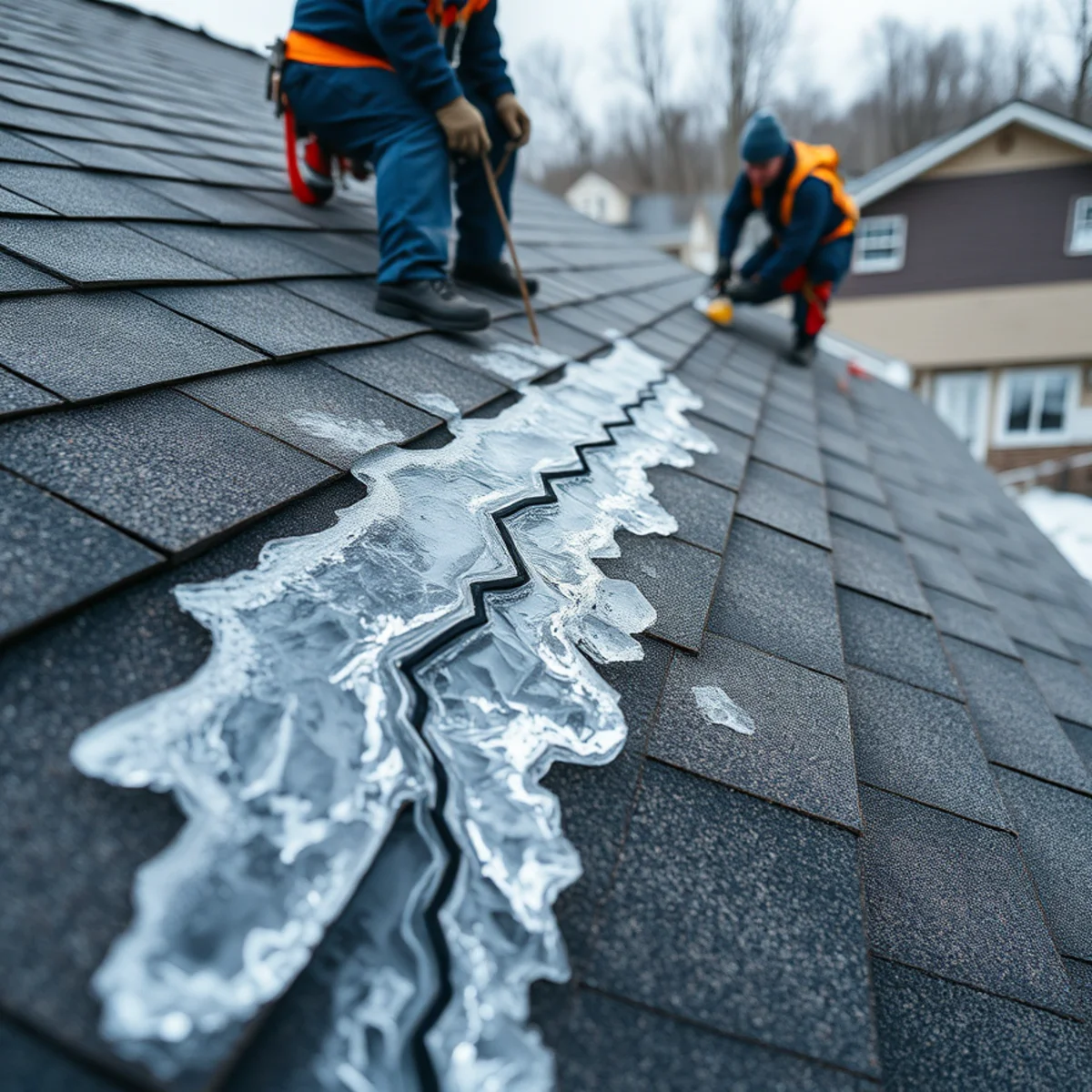
Heat escaping into the attic warms the roof deck. Snow melts on the upper roof, runs down to the cold overhanging eave, and refreezes into a ridge. Water pools behind that ridge and, having nowhere else to go, works back up under the shingle courses and into the structure.
Shingles are designed to shed running water, not to hold back standing water. Nothing about a conventional shingle roof resists that except the ice and water shield underneath — which is precisely why we install it well past the interior wall line on every roof we replace. See ice dam removal and repair.
Mechanism 3: attic condensation that is not a leak at all
A meaningful share of January 'leaks' we are called out for are condensation.
Warm moist air from the house rises into a cold attic, hits the underside of the sheathing, and freezes there. When temperatures rise a few degrees, all that frost melts simultaneously and rains onto the insulation and ceiling below.
It produces stains that look exactly like a roof leak, and no amount of roof repair will stop it. The fix is air sealing, ventilation, and ducting bathroom fans to the outside rather than into the attic.
We check for it on every winter leak call, because telling someone they need roof work when they need a properly ducted bath fan is how homeowners end up spending money twice.
Mechanism 4: material movement
Everything on a roof expands and contracts with temperature, and different materials do it at different rates.
Metal flashing moves considerably more than the wood it is fastened to and far more than masonry. Across a winter of daily temperature swings, that differential works fasteners loose, opens sealed joints and fatigues laps.
It is the reason sealant is a poor substitute for properly formed and mechanically fastened flashing in this climate. Caulk that looked fine in September has been worked back and forth several hundred times by March.
Where winter leaks show up
- At the top of exterior walls upstairs — the classic ice dam signature; the water is inside the wall cavity
- Around chimneys — masonry, metal and roofing all moving at different rates
- In valleys — where ice accumulates most and drainage is most concentrated
- At skylights — particularly at the head, where snow and ice pile against the curb
- Along the eave line — behind ice dams and frozen gutters
- Randomly across a ceiling — which usually means condensation rather than a roof leak
What actually protects a roof through a Central PA winter
Ice and water shield at eaves, valleys and every penetration, run generously — this is the single most important winter detail in this climate, and cheap quotes cut it first.
Flashing formed in metal and mechanically fastened rather than caulked. Balanced attic ventilation so the deck stays cold. Air sealing so warm moist air is not getting up there to begin with. Gutters cleared before the first freeze so meltwater can leave.
And repairs done in autumn rather than deferred. A marginal detail in October is a leak in January — that is the whole lesson of this article.
What this means for your roof
The lesson is seasonal rather than technical. Everything marginal in autumn becomes an opening by spring, because freeze-thaw is a mechanical process that runs dozens of times a winter whether or not anyone is watching.
Which is why we push autumn repairs hard. A cracked pipe boot in October is a cheap scheduled visit; the same boot in January is an emergency dispatch on a wet roof in the dark. See roof repair.
Questions we get about this
Why is my roof leaking in winter when it is not raining?
Two common causes here, and neither is rain. Snowmelt backing up behind an ice dam is the first. Attic condensation melting during a warm spell is the second — and that one produces a stain pattern identical to a roof leak while no amount of roof work will fix it.
Does freeze-thaw damage metal and slate too?
Less. Metal has no porosity for water to invade and slate is dense stone, so both are far more resistant than asphalt. What still fails on those roofs is the fastenings and the sealant at masonry intersections, which is why we detail those in metal rather than caulk.
How many freeze-thaw cycles does Harrisburg get?
Enough that it is the defining winter stress here rather than absolute cold. Central Pennsylvania crosses the freezing point repeatedly through the season, and each crossing drives water into a crack, expands it and reopens the gap slightly wider.
Need help with this in Harrisburg?
We are a licensed and insured roofing contractor based at 1000 N Cameron St in Harrisburg. Free inspections, written reports and honest recommendations.
Related services
Areas mentioned