Prevention & Maintenance
Spring Storm-Season Roof Inspection Checklist (Central PA Edition)
Winter did things to your roof that you will not see until summer storms exploit them. Here is the spring checklist that catches them first.

The short answer
Spring inspection assesses what winter did before summer storms exploit it. Walk every elevation from the ground, look hard at the eave line where ice dams work, check that gutters are still pitched after carrying ice, and get into the attic for evidence of water that came in during the thaw.
Spring inspection has a different purpose from the autumn one. In autumn you are preparing for winter. In spring you are assessing the damage winter did, before storm season arrives to exploit it.
In Central Pennsylvania that matters, because our summer brings high-wind thunderstorm complexes and hail into a valley that channels weather. A marginal detail that survived February will not survive July.
What winter actually does to a roof
- Freeze-thaw enlargement — every micro-crack and open joint on your roof was cycled dozens of times and each cycle made it slightly bigger
- Ice dam damage — lifted shingles, damaged underlayment, and displaced eave flashing, often with no interior leak yet
- Fastener movement — differential expansion works nails and screws loose over a season
- Sealant failure — caulk that looked fine in September has been worked back and forth hundreds of times
- Snow and ice load deflection — gutters pulled loose, hangers stretched, fascia stressed
- Wind damage from winter storms — seal strips broken by nor'easters, often unnoticed
The ground-level walk
Every elevation, with binoculars
Missing, lifted, curled or creased shingles. Compare elevations — damage concentrated on one side points to wind direction.
Ridge and hip lines
Cap shingles are the most exposed on the roof and the most common winter casualty.
The eave line specifically
This is where ice dams did their work. Look for lifted shingles, exposed nail heads and displaced drip edge.
Gutters and their alignment
Sagging, separated joints, pulled hangers, and any section that is now out of pitch after carrying ice.
Downspouts and discharge
Confirm they are connected, clear, and discharging away from the foundation.
Fascia and soffit
Staining, peeling paint, soft spots or sagging panels — all evidence of water that got behind the gutter over the winter.
The attic check
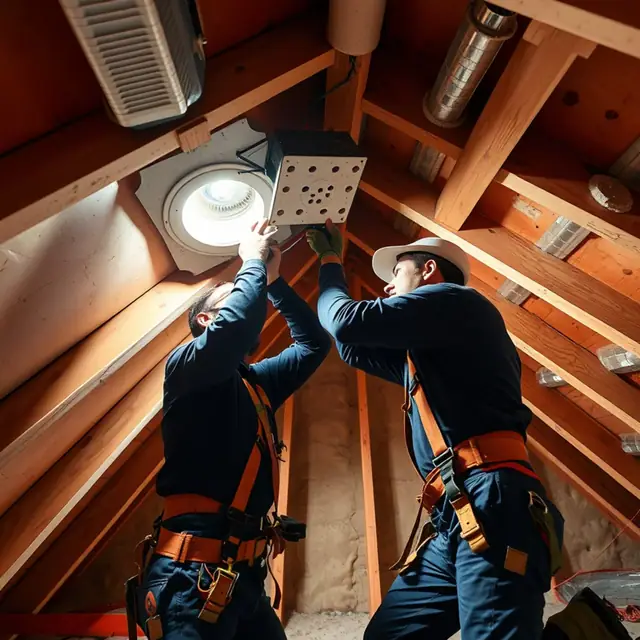
Go up on a dry day and take a flashlight. You are looking for evidence of winter water.
New or expanded stains on the sheathing. Damp or matted insulation, particularly near the eaves where ice dam water arrives. Rusty nail points, which indicate condensation. Any daylight visible at penetrations, valleys or the ridge.
Also check the eaves for whether insulation has shifted and blocked the intake path over the winter — it happens, particularly where someone has been in the attic.
The gutter clearing that matters
Spring gutter cleaning gets overshadowed by autumn, and it should not. Everything that blew in over the winter is in there, plus whatever was left in November, and in Harrisburg's older neighborhoods the maple seed drop is about to add substantially more.
Clear the trough and the downspouts, then run water through and watch. Check that the pitch is still correct after a winter of ice loading — a gutter that carried ice all February may have sagged, and standing water in the trough is the start of the next problem.
For a schedule that reflects Harrisburg's tree cover, see how often to clean gutters in Central Pennsylvania.
Book professional attention for these
- Any evidence of ice dam water intrusion — even where there was no visible interior leak
- Flashing that moved — chimney, sidewall or skylight flashing that looks displaced or has open joints
- Sealant-only repairs from previous years — these fail over a winter and should be rebuilt in metal
- Lifted shingles at the eave — a classic ice dam signature that needs replacing rather than pressing back down
- Gutters out of pitch or with pulled hangers — before spring rains overwhelm them
- Anything you cannot see well from the ground — a professional inspection is free and takes under an hour
Get ahead of storm season
Central PA's severe weather season runs from spring into late summer, with the highest-risk period for wind and hail in the warmer months.
Two things worth doing before it arrives. First, photograph your roof's current condition from every elevation — a documented before-state makes any subsequent storm claim dramatically simpler. Second, get any known defect repaired, because storm damage on top of a pre-existing problem gets messy in a claim.
And after any significant storm, get inspected even if nothing looks wrong. Ours is free — see storm damage roof repair.
What to do next
Two things are worth doing before Central PA's storm season arrives. Photograph your roof from every elevation, because a documented before-state makes any subsequent claim dramatically simpler. And repair anything you found, because storm damage layered on a pre-existing defect gets messy in a claim.
Then after any significant storm, get inspected even if nothing looks wrong. Broken seal strips are invisible from the ground and they are the damage that decides the next storm's outcome. See storm damage roof repair.
Questions we get about this
What does winter actually do to a roof?
Four things. Freeze-thaw enlarges every micro-crack and open joint. Ice dams lift shingles and damage underlayment at the eave, often without an interior leak. Differential expansion works fasteners and sealant loose. And winter storms break seal strips that nobody noticed at the time.
Should I clean gutters in spring as well as autumn?
Yes, and it gets overlooked. Everything that blew in over winter is in there, the maple seed drop is about to add substantially more, and a gutter that carried ice all February may have sagged out of pitch. Run water through and watch where it goes.
How do I know if ice dams damaged my roof?
Look along the eave line for lifted shingles, exposed nail heads and displaced drip edge, and check the attic near the eaves for staining or damp insulation. Ice dam damage frequently occurs without ever producing a visible interior leak — which is exactly why spring is when to find it.
Need help with this in Harrisburg?
We are a licensed and insured roofing contractor based at 1000 N Cameron St in Harrisburg. Free inspections, written reports and honest recommendations.
Related services
Areas mentioned