Cost & Insurance
Flat Roof Replacement Cost for Harrisburg Rowhomes
Two identical rowhome roofs can differ in price by half, and the reason is almost never the membrane. It is what is underneath it.
The short answer
Two identical rowhome roofs can differ in price by half, and the membrane is rarely the reason. What decides it is how many layers are up there, whether the insulation is saturated, what condition the deck is in, and whether the drainage has to be corrected. A test core answers all four.
Flat roof quotes confuse Harrisburg homeowners more than any other kind, because two houses of identical size on the same block can come back with wildly different numbers.
The reason is that on a low-slope roof, the membrane is a modest share of the cost. The expensive variables are what is underneath — how many layers, whether the insulation is wet, what condition the deck is in — and what has to happen to the drainage.
Here is how to read a flat roof quote.
The one thing that decides your price: the test core
A test core is a small square cut through the entire roof assembly down to the deck. It takes ten minutes and it answers everything.
It tells you how many roofing layers are actually up there. It tells you whether the insulation is dry or saturated. It tells you what the deck is made of and what condition it is in. And it is the difference between a quote based on evidence and a quote based on a guess.
If a contractor quotes your rowhome roof without coring it, they are pricing on assumption. That assumption will be either optimistic — producing a change order once the tear-off starts — or padded to cover the risk. Either way you are paying for the uncertainty.
What the core tells you, and what it costs
| Core finding | What it means | Cost impact |
|---|---|---|
| One or two dry layers, sound deck | Re-cover may be permitted | Lowest — no full tear-off |
| Three or more layers | Code generally requires tear-off | Higher labor and disposal tonnage |
| Wet insulation | Must be removed; cannot be covered | Significant — removal, disposal by weight, new insulation |
| Soft or delaminated deck | Sheathing replacement | Priced per sheet plus the labor to get to it |
| Ponding with deck deflection | Drainage correction needed | Tapered insulation or framing work as its own line |
Drainage: the line item people try to cut
If your rowhome roof ponds — water still standing 48 hours after rain — patching the membrane without fixing the drainage is a repeat visit waiting to happen.
There are three real answers. Tapered insulation builds slope into the new assembly so water is directed to the drain or scupper; it is the cleanest fix when the deck is sound. Sleeper framing with a new deck is the answer when joists have sagged. Adding or relocating a drain or scupper is the answer when the water is going to the wrong corner entirely — which happens constantly on rowhomes re-roofed by whoever was cheapest decades ago.
All three are visible line items. All three are worth paying for. Details in ponding water on a flat rowhome roof.
Access on a Harrisburg rowhome
This is a genuine cost factor that suburban roofing never encounters.
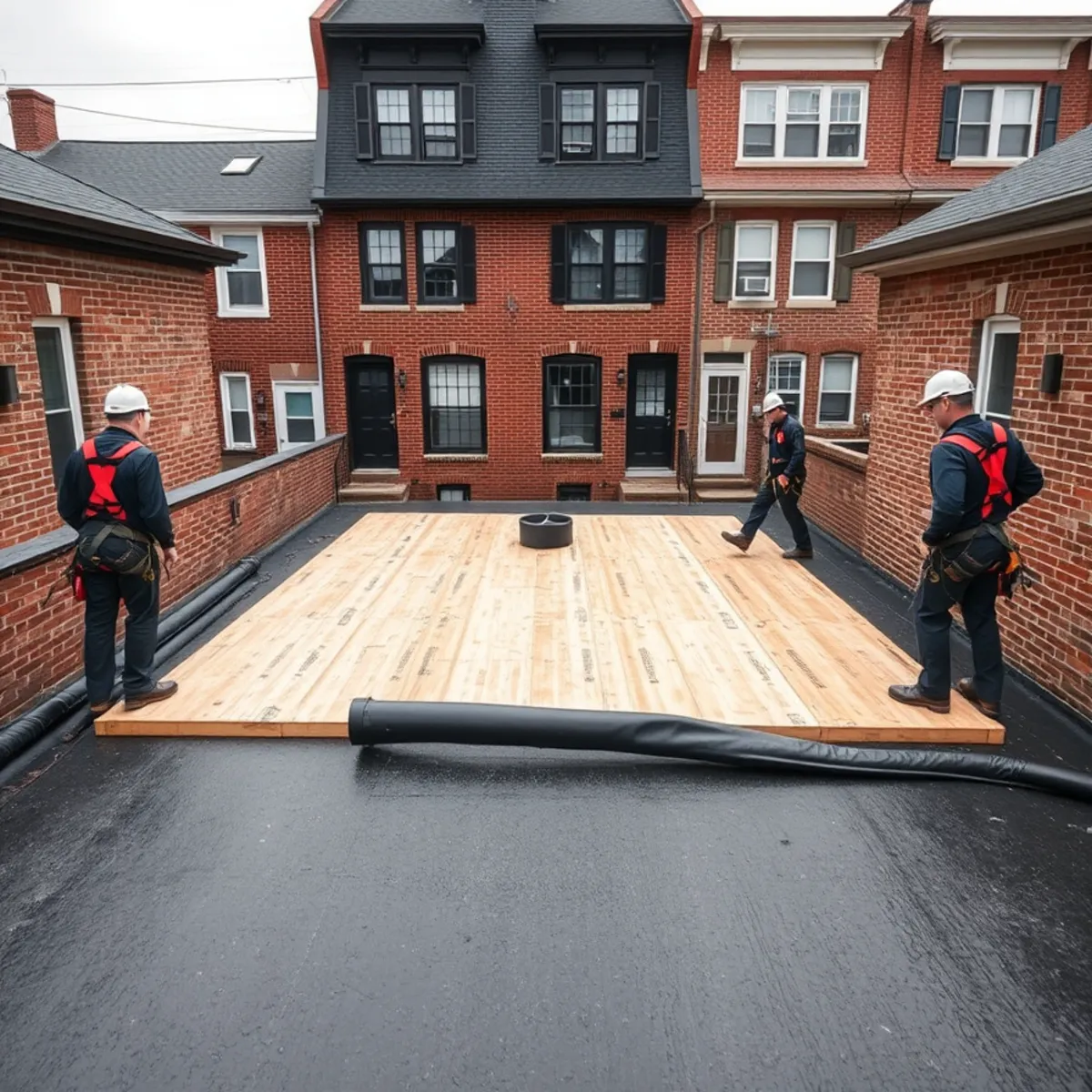
Many blocks in Allison Hill, Midtown and Camp Curtin have no rear alley, or an alley too narrow for a dumpster. Material and debris then go through the house — which means interior protection on stairs and floors, hand-carrying every roll and every bundle, and considerably more labor hours than a job where a truck backs up to the eave.
An honest quote states how access will be handled. A quote that does not address it either has not looked or is going to raise the issue on day one.
Party walls are their own scope
Your membrane terminates into walls shared with the houses on either side, and that termination protects both properties.
Done properly it means a mechanically fastened termination bar, counterflashing where the masonry allows, and sealed coping joints — not mastic smeared at the top of the membrane. It should be its own line on the estimate and it should be photographed on completion.
This is also the most common source of the neighbor dispute that follows a cheap re-roof, and it is worth getting right.
Membrane choice — a smaller variable than you think
- EPDM (rubber) — handles Central PA temperature swings well, easy to repair years later, the default for most residential rear sections
- Modified bitumen — multi-ply, tough underfoot, forgiving around complex parapet and chimney detailing; common on rowhomes
- TPO — reflective white surface, heat-welded seams; more at home on commercial decks than a small residential rear roof, where it streaks visibly
- Liquid coating — only appropriate over a dry, sound assembly. Over wet insulation it seals moisture in and shortens the deck's life
Reading two quotes fairly
Line them up and compare: number of layers assumed for tear-off, whether wet insulation removal is included or excluded, deck replacement rate and allowance, drainage correction scope, party-wall termination method, membrane type and thickness, warranty term, and how access is being handled.
If one quote is dramatically lower, the difference is almost certainly in one of those lines. Ask which.
What to do next
Insist on a test core before anyone quotes your flat roof. It takes ten minutes, it costs almost nothing, and it is the difference between a firm number and a padded guess that becomes a change order on day one.
Then read the quotes for four lines specifically: layers assumed for tear-off, whether wet insulation removal is included, the drainage correction, and the party-wall termination method. That is where the money and the longevity both sit — see flat and low-slope roofing.
Questions we get about this
Why is my rowhome flat roof quote so much higher than my neighbour's?
Almost always what is underneath. Their roof may have one dry layer over a sound deck; yours may have three layers, saturated insulation billed out by disposal weight, and a deck that needs sheathing replaced. Same street, same size, very different job.
Can a flat roof be re-covered instead of torn off?
Where code permits another layer and a core shows the assembly is dry, yes — and it saves substantial disposal cost. Over wet insulation it is a false economy that seals moisture into the deck.
Who pays for the party wall between two rowhomes?
Generally each owner is responsible for their own half, but the flashing at the shared line protects both. Where neighbours re-roof in the same season, doing them together is cheaper per house and eliminates the argument about whose termination caused the leak.
Need help with this in Harrisburg?
We are a licensed and insured roofing contractor based at 1000 N Cameron St in Harrisburg. Free inspections, written reports and honest recommendations.
Related services
Areas mentioned