Roof Problems Explained
Attic Ventilation: The Hidden Killer of Builder-Grade Roofs
A ridge vent with nothing feeding it is decoration. It is also the most common reason suburban Dauphin County roofs die a decade early.
The short answer
A ridge vent with no working soffit intake does nothing. Air cannot exit a space it cannot enter, so the ridge vent pulls conditioned air out of your house instead — and the attic cooks in July, holds moisture in January, and ages the shingles from underneath where nobody is looking.
If we could fix one thing about the housing stock in Lower Paxton, Susquehanna Township, Camp Hill and every 1980s and 1990s development in this county, it would be this.
Thousands of homes here have a ridge vent running the length of the roof and no functioning intake at the soffit. The ridge vent looks like ventilation. It is not doing anything, because air cannot exit a space it cannot enter.
The result is roofs failing at fifteen to twenty years that should have made thirty, ice dams every winter, and heating and cooling bills paying for the privilege.
How attic ventilation is supposed to work
It is a simple physical system. Cool outside air enters low, at the soffit. It rises through the attic as it warms, carrying heat and moisture with it, and exits high, at the ridge. That continuous flow keeps the attic close to outdoor temperature and the roof deck dry.
Both halves are required. Exhaust without intake is a closed system — the ridge vent can only pull air from somewhere, and with no soffit intake it pulls conditioned air out of your house through every ceiling penetration instead. That is worse than no ventilation at all, because now you are paying to heat and cool the attic.
Why so many houses have it wrong
- Soffits were never vented — solid wood or unperforated aluminum panels, extremely common on pre-1970s construction
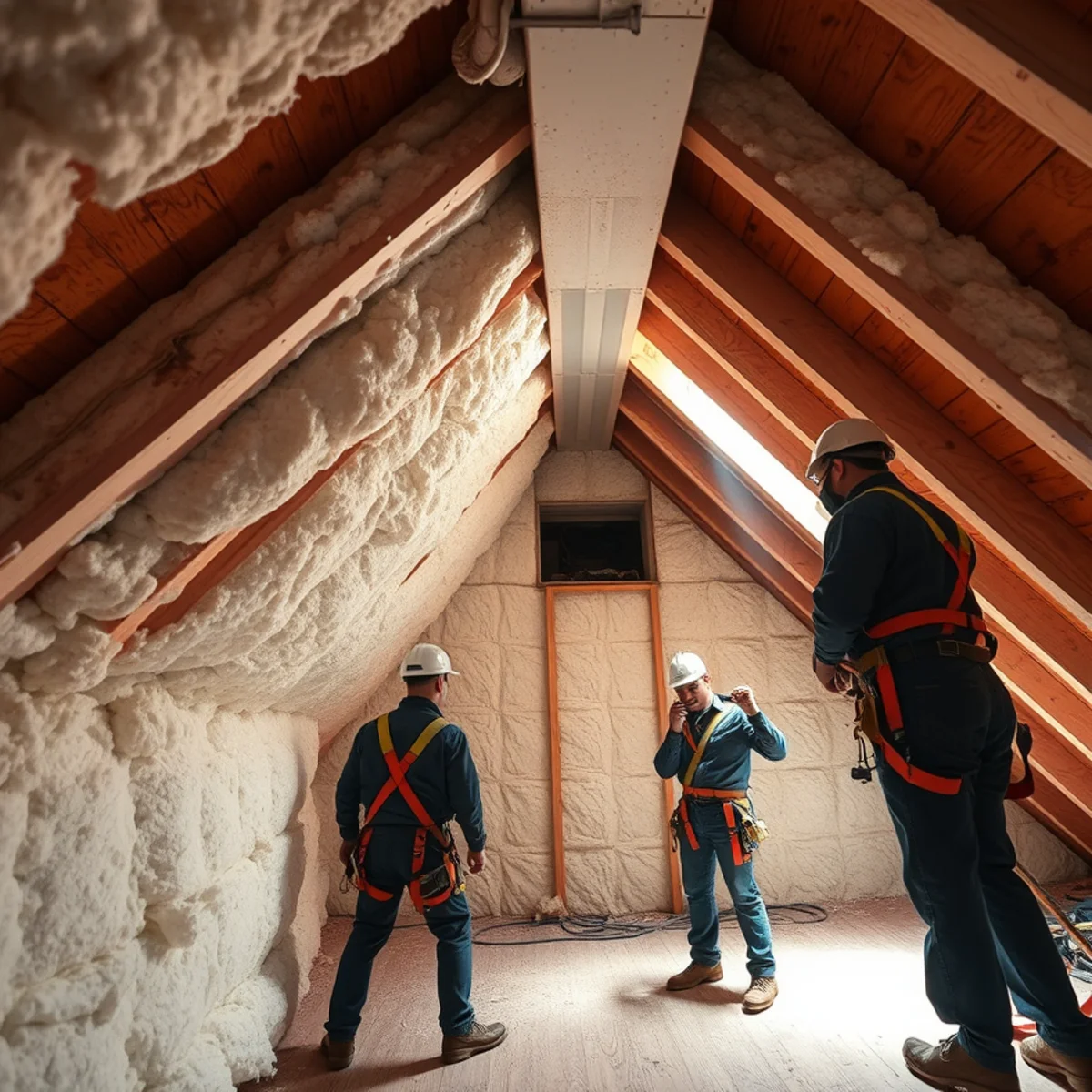
- Insulation was blown in and packed to the eaves, sealing the intake path from inside. This is the most common cause and it happened during well-intentioned energy upgrades
- Ridge vent added during a re-roof with no intake work — a roofer installed the visible half and skipped the invisible half
- Mixed exhaust types — a ridge vent plus gable vents plus a powered fan can short-circuit each other, pulling air from the nearest opening rather than from the soffit
- Bathroom fans venting into the attic rather than through the roof or wall, dumping moisture directly into the space
Check your own attic in ten minutes
Go up on a hot afternoon
A properly ventilated attic in July will be warm but tolerable. If it is dramatically hotter than outside and the air is completely still, you have a ventilation problem.
Look at the eaves
Get to where the roof meets the exterior wall. Can you see daylight through the soffit? Is insulation jammed right up into that corner? If there is no visible gap and no baffle, there is no intake.
Look for baffles
Baffles are channels — usually cardboard or plastic — that hold insulation back from the eave and keep an air path open. If your attic has blown insulation and no baffles, the intake is almost certainly blocked.
Check the underside of the sheathing
Dark staining, mold, or in winter, frost. All of them mean moisture that has nowhere to go.
Find where the bath fans go
Follow the ducts. If they end in the attic rather than at a roof or wall termination, that is a significant moisture source and an easy fix.
What proper ventilation costs and buys
Correcting intake means either replacing solid soffit panels with vented ones, or cutting continuous intake vents into the soffit, and installing baffles at every rafter bay so insulation cannot re-block the path.
It is real carpentry and it appears as its own line on our estimates, typically a modest fraction of a full replacement. What it buys is substantial: the difference between a roof reaching its rated life and repeating the last one's history, meaningfully fewer ice dams, a cooler house in summer, and a manufacturer warranty that actually stands up.
That last point is worth emphasizing. Shingle manufacturers void warranties for inadequate ventilation and they do enforce it. A homeowner with a fifteen-year-old roof failing early may find the warranty claim declined for exactly this reason.
How much ventilation you actually need
The standard rule of thumb is one square foot of net free ventilating area for every 150 square feet of attic floor, or 1:300 where a vapor barrier is present and the ventilation is balanced between high and low.
The critical word is balanced. Roughly half the net free area should be intake at the soffit and half exhaust at the ridge. An attic with a great deal of exhaust and little intake is not half-ventilated — it is malfunctioning.
We calculate this against your actual attic square footage rather than installing whatever length of ridge vent the roof happens to be.
Ventilation and ice dams are the same problem
Everything above is also the ice dam story. A hot attic melts snow on the roof deck. The meltwater runs to the cold eave and refreezes. Repeat and you have a dam with standing water behind it working under your shingles.
Air sealing, insulation and ventilation are the three-part permanent fix for both problems simultaneously — see how to prevent ice dams and our ice dam removal service.
What to do next
Go into your attic on a hot afternoon and look at the eaves. If the air is still, the space is oven-like and insulation is packed hard against the underside of the deck with no baffles, you have found the reason your last roof did not reach its rated life.
Correcting intake is real carpentry and it belongs in the scope of any replacement rather than as an upsell. It is also what keeps the shingle warranty enforceable — manufacturers void them for inadequate ventilation and they do enforce it. See roof replacement.
Questions we get about this
How much attic ventilation do I actually need?
The rule of thumb is one square foot of net free ventilating area per 150 square feet of attic floor, or 1:300 where a vapour barrier is present and intake and exhaust are balanced. The critical word is balanced — roughly half at the soffit and half at the ridge.
Can I have too much roof ventilation?
You can have the wrong mixture. A ridge vent combined with gable vents and a powered fan can short-circuit each other, pulling air from the nearest opening rather than drawing it up from the soffits. More exhaust is not the same as more ventilation.
Do bathroom fans cause attic problems?
Constantly, when they terminate in the attic rather than outside. That is a continuous moisture source directly under your roof deck, and it produces frost on the sheathing in winter that melts into the insulation during a thaw. It is one of the cheapest fixes available.
Need help with this in Harrisburg?
We are a licensed and insured roofing contractor based at 1000 N Cameron St in Harrisburg. Free inspections, written reports and honest recommendations.
Related services
Areas mentioned